


Applying the latest advances in AI to payments
If you feel like the speed of AI progress is getting faster, you’re not alone. New model releases are now so rapid that, on LMArena—one of the most‑watched public leaderboards—the top model now remains #1 for an average of only 35 days.
Given how quickly the GenAI field is evolving, Findustry AI®’s customers and partners count on us to help them stay at the frontier. At the model layer, that means leveraging the latest models in payments workflows as soon as they prove themselves in our Benchmark. At the application layer, it means engineering the systems around those models that turn raw intelligence into an AI payments employee.
We just launched the latest of those systems: Merchant Memory, which enables our AI agents to remember your policies and preferences. Now, your interactions with Chargeback Agent™ make its future responses even more tailored to the way you work.
As a result, one merchant’s Chargeback Agent will behave differently than another merchant’s: Chargeback Agent is customized based on what it learns about your business, your chargeback responses, and your decisions. This is another way the AI system continuously improves after deployment.
With Merchant Memory, Chargeback Agent is customized based on your business, your chargeback responses, and your decisions.
—Jonathan Razi, Findustry AI Founder & CEO
How Merchant Memory makes Chargeback Agent even more useful
The goal of Chargeback Agent is to automate dispute workflows: the AI agent collects evidence, builds arguments, and sends the completed response to the acquirer.
And, just like a human coworker, the AI agent should learn on the job. Chargeback Agent should not only know which cases to resolve autonomously and which to escalate for additional review, but also remember how you handle escalations so future responses are even smarter.
Beyond simple rules based on dollar amount, many merchants have nuanced preferences for which chargebacks they fight, what evidence they upload, and the language they include in rebuttals. They may also have a personal style for how they start and end cover letters. When our AI agent generates a rebuttal on their behalf, these details should be in its context.
These are all reasons why we built Merchant Memory into Chargeback Agent.
Designing Merchant Memory to work automatically
Before you log into our portal for the first time, Chargeback Agent has already added to its memories, and this process continues as you work with the system. There are three ways memories are added:
- 1What the AI agent learns about your business during onboarding, so Chargeback Agent is informed by your actual policies (for example, your refund policy), and suggested evidence makes sense in your business context.
- 2Actions you take such as uploading additional evidence, deleting evidence, or editing letter drafts, so Chargeback Agent builds future responses the way you would.
- 3Explicit instructions you give the AI agent, such as how to describe merchandise or to always bold account numbers in response letters.
As we built Merchant Memory, we knew that, while learning would happen automatically as customers use the product, users should also have a way to review memories and make adjustments or directly add instructions. Merchant Memory includes a UI for merchants to review and edit memories in Settings.
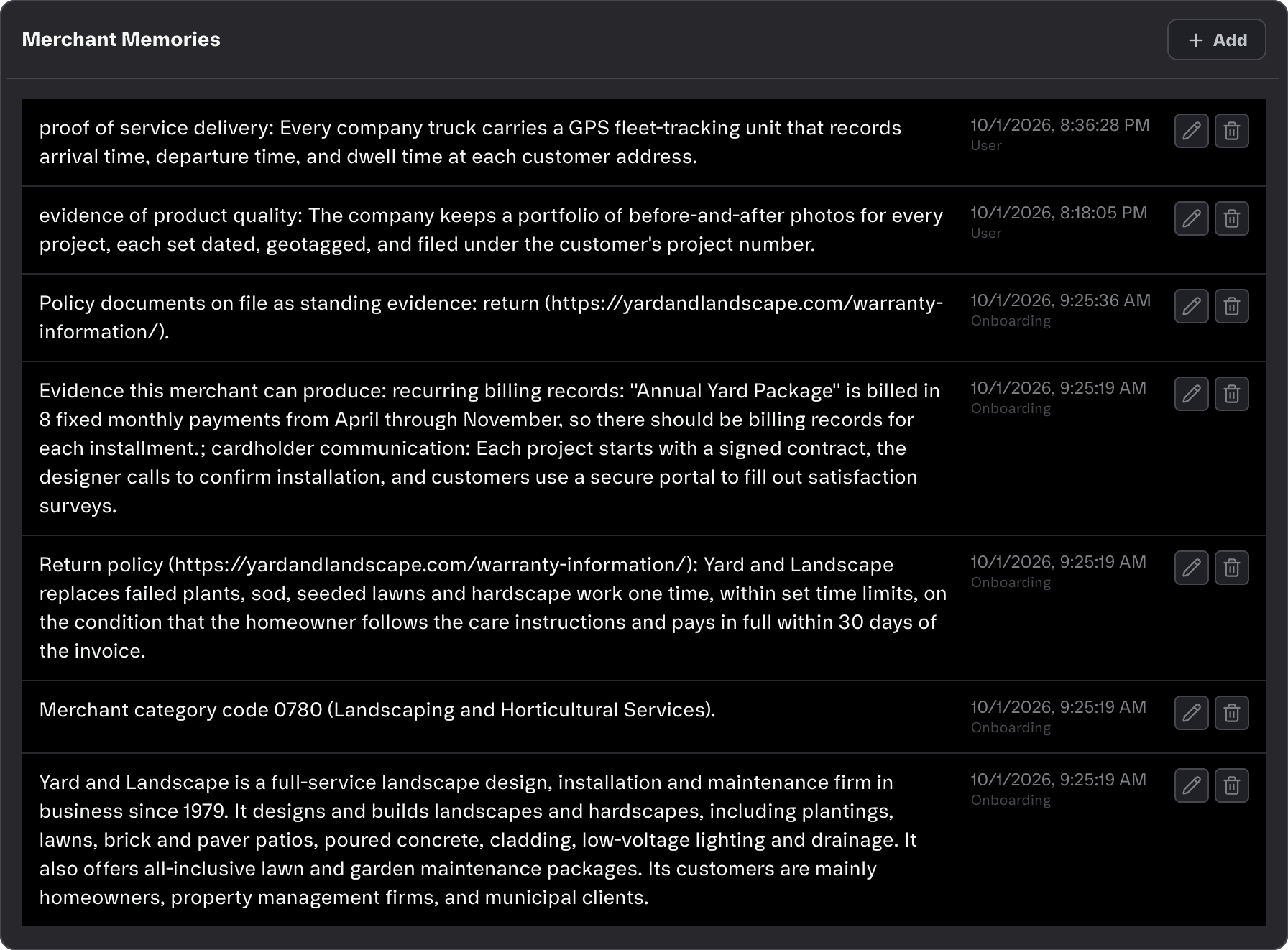
Customers tell us that, before deploying Chargeback Agent, manual chargeback responses took two hours or more. With Merchant Memory, responses are not only built automatically, but personalized based on their organization, their policies, and their brand voice—which is another step towards our vision of empowering merchants of all sizes with an AI payments employee.
Ready to apply state-of-the-art LLM engineering to payments?
If we can help your organization, reach out to Findustry AI today.